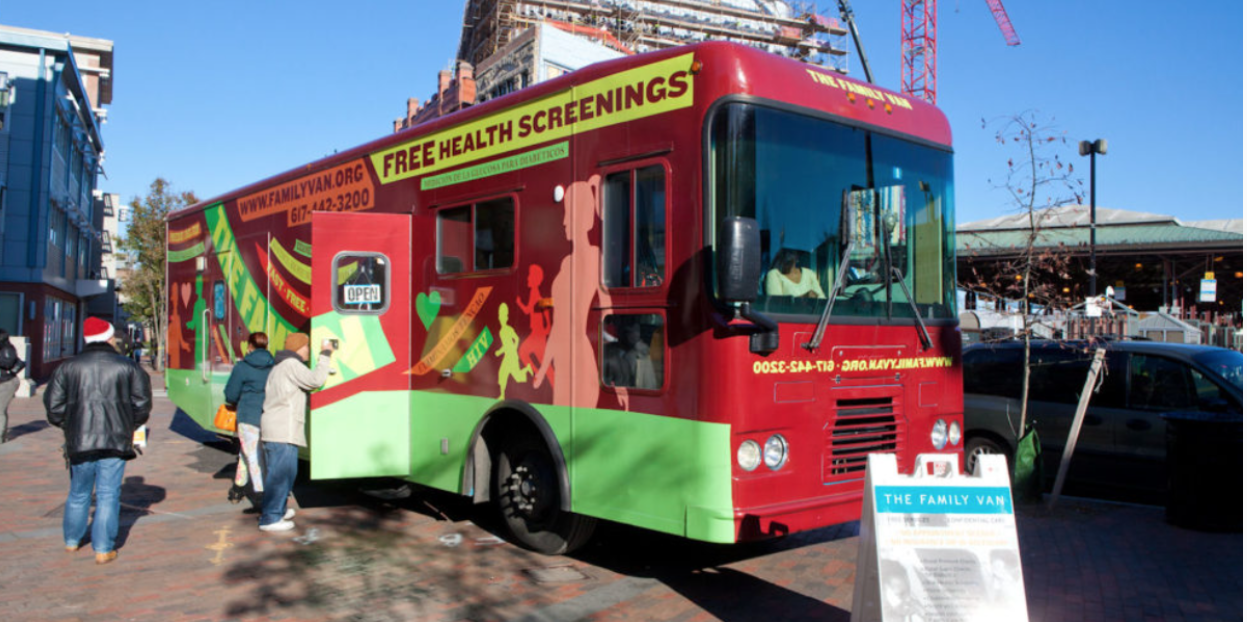
The Family Van + Harvard Medical School:: The Hidden Value of Mobile Healthcare
For generations, healthcare has operated according to a simple assumption::
Patients come to care.
Hospitals, clinics and medical offices are designed around this expectation. Patients are responsible for navigating transportation, schedules, insurance requirements and unfamiliar systems in order to access the services they need.
But what if one of the greatest barriers to health is the assumption itself?
Working with Harvard Medical School and The Family Van—one of the nation's most respected mobile healthcare programs—GREEN::HOUSE set out to better understand the role mobile clinics could play in the future of healthcare delivery.
At first glance, mobile clinics appear to solve a logistical problem.
They bring healthcare into communities where access is limited.
But our research revealed something far more significant.
The greatest value of mobile healthcare is not mobility.
It is proximity.
By meeting people where they live, work and gather, mobile clinics fundamentally alter the social dynamics of healthcare.
Traditional healthcare environments often reinforce power imbalances. Patients enter unfamiliar institutions governed by specialized language, complex procedures and implicit expectations. For many individuals—particularly those who have experienced barriers to care, distrust of institutions or systemic inequities—these environments can create anxiety, disengagement and resistance.
Mobile clinics reverse that equation.
They enter the patient's world.
In doing so, they create opportunities for more authentic relationships, increased trust and a greater sense of personal agency. Patients are often more willing to ask questions, share concerns and engage in conversations about their health when those interactions occur in familiar environments and on more equal footing.
The implications are profound.
When patients feel seen, respected and empowered, adherence to treatment improves. Preventive care becomes more accessible. Health information becomes more actionable. And individuals become more active participants in their own wellbeing.
In short, mobile healthcare changes not only where care occurs, but how care is experienced.
The project also explored a provocative question::
What if we studied trust with the same rigor that we study medicine?
GREEN::HOUSE proposed embedding highly attentive graduate researchers alongside mobile healthcare teams to observe interactions in real-world settings. By collecting data across diverse communities and circumstances, researchers could begin identifying the specific behaviors, conditions and social dynamics that help patients feel safe, empowered and receptive to medical guidance.
Such insights could transform not only mobile healthcare, but healthcare delivery more broadly.
The work anticipated many of the conversations now shaping the future of health systems, including the growing recognition of social determinants of health, community-based care, patient engagement and health equity.
Rather than viewing health outcomes solely through a clinical lens, the project highlighted the importance of understanding the social environments, relationships and lived experiences that influence health behaviors long before a patient enters a hospital.
The insights generated through the engagement informed subsequent GREEN::HOUSE work related to the social determinants of health, including contributions to the development of graduate nursing education at the USC Suzanne Dworak-Peck School of Social Work.
For GREEN::HOUSE, the project reinforced a central belief::
The future of healthcare is not simply about delivering better medicine.
It is about creating better relationships between people and the systems designed to serve them.
Because when care meets people where they are, health becomes more than a service.
It becomes a partnership. ::
For further reading on our work in health + wellness, see the BSP, University of Southern California, Walter Reed, and Ovarian Cancer Project reports.