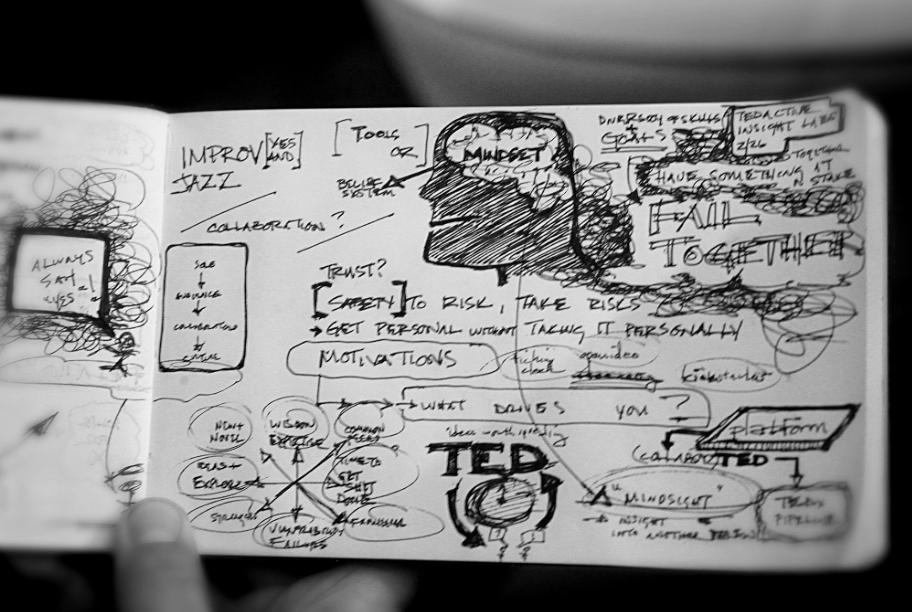
TED Conferences:: Discovering the Dynamics of Transcendent Interest
Why do some people collaborate across differences while others do not?
Why do certain movements, causes and ideas inspire extraordinary collective action while others struggle to gain traction?
And what allows individuals and organizations with competing interests to unite around a common purpose large enough to change the world?
These were among the questions that emerged when TED Conferences approached GREEN::HOUSE to explore ways of increasing participation in—and amplifying the impact of—the global TED Prize.
At the time, the TED Prize represented a bold experiment in collective action. Each year, a visionary recipient would present a world-changing wish and invite individuals, organizations and communities around the globe to help make it a reality.
Yet the challenge was larger than engagement.
The challenge was understanding the conditions under which people choose to act together in pursuit of a shared future.
What began as a strategic engagement evolved into a deeper investigation of collaboration itself.
Through research and analysis, GREEN::HOUSE identified and articulated a concept that has since become foundational to our understanding of social innovation and collective action: Transcendent Interest.
Unlike traditional models of cooperation, transcendent interest is not based on overlapping self-interest.
It is not a compromise.
It is not a transaction.
And it is not what is commonly described as a "win-win."
In conventional collaboration, individuals or organizations work together because doing so advances their existing goals. The interests of the parties overlap, creating mutual benefit.
Transcendent Interest operates differently.
It emerges when individuals become committed to a future state that is more important than their original interests. Rather than negotiating among competing priorities, participants become oriented toward a larger possibility that transforms how they understand themselves, one another and the challenge before them.
In this condition, collaboration ceases to be an exchange.
It becomes a shared act of creation.
The research revealed several characteristics common to transcendent interest.
Participants often experience a temporary suspension of individual identities and institutional boundaries. Original interests become less significant in relation to the larger objective. New forms of value emerge that were previously inaccessible to any party acting alone. Most importantly, people begin organizing themselves around a future that does not yet exist, but which they collectively believe can be brought into being.
This insight helped illuminate why some social movements, civic initiatives and collaborative ventures achieve extraordinary levels of engagement while others remain limited by the competing interests of their participants.
The work informed thinking around the TED Prize and provided a new lens through which to understand large-scale cooperation, innovation and social change.
For GREEN::HOUSE, the discovery reinforced a central belief::
The greatest breakthroughs rarely occur when people find common ground.
They occur when people discover higher ground.
Transcendent interest continues to influence our work with coalitions, institutions, nonprofits, universities and civic leaders seeking to unite diverse stakeholders around ambitious goals that no individual, organization or sector can achieve alone.
Because the future is not built through agreement.
It is built through shared commitment to something larger than ourselves. ::
Transcendent Interest emerges when individuals become committed to a future state that is more important than their original interests. Rather than negotiating among competing priorities, participants become oriented toward a larger possibility that transforms how they understand themselves, one another and the challenge before them.